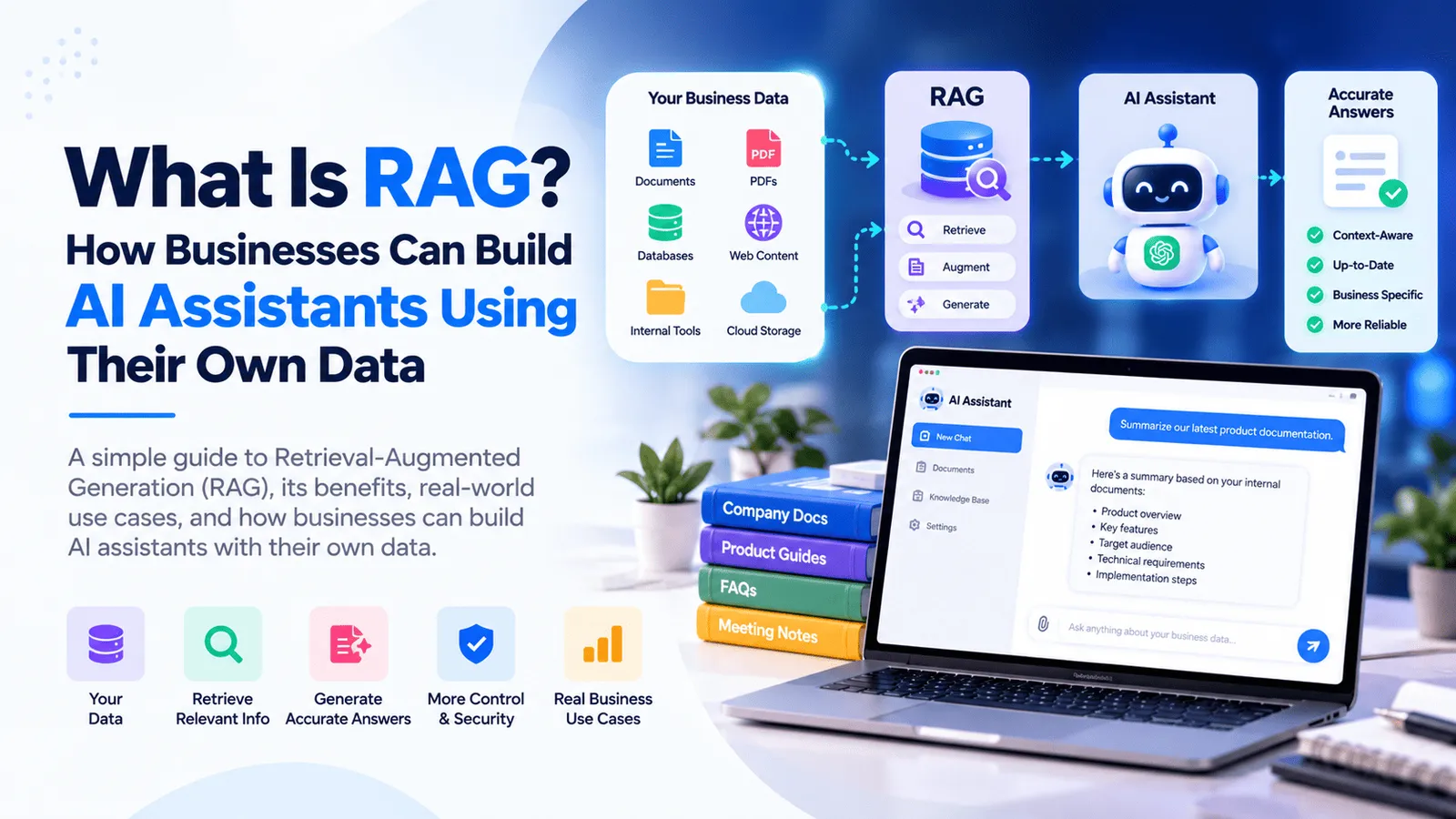
What Is RAG? How Businesses Can Build AI Assistants Using Their Own Data
Businesses are increasingly exploring artificial intelligence to improve customer support, automate repetitive tasks, and help employees find information faster. However, many companies face an important challenge: general-purpose AI models do not automatically know their latest product documentation, internal policies, customer records, or confidential business information.
This is where Retrieval-Augmented Generation (RAG) becomes useful. RAG allows an AI application to retrieve relevant information from an approved knowledge source and use that information to generate a contextual answer.
Instead of relying only on information learned during model training, a RAG-based AI assistant can search your company documents, help articles, product manuals, operational guidelines, and other authorized sources when responding to a question.
For example, an employee could ask about a company policy, a customer could ask how a product feature works, or a support agent could search technical documentation through a conversational interface.
In this guide, we explain what RAG is, how it works, how businesses can build an AI knowledge base using their own data, which technologies are involved, and what to consider when implementing an enterprise AI assistant.
What Is Retrieval-Augmented Generation (RAG)?
Understanding RAG in Simple Terms
Retrieval-Augmented Generation is an AI architecture that combines information retrieval with a generative AI model. When a user asks a question, the system searches a knowledge source for relevant information and provides the retrieved content as context to the model.
The model then uses the question and retrieved information to generate a response. Depending on the implementation, the answer can also include references to the documents or passages used to prepare it.
Think of RAG as an AI assistant that can look up relevant information from your business knowledge base before answering a question, instead of relying only on its existing model knowledge.
For example, imagine that your organization has hundreds of product manuals and internal support documents. Rather than asking employees to search each document manually, you could provide an AI assistant that retrieves relevant sections and explains the answer in natural language.
RAG does not automatically make every answer correct. The quality of the result depends on the relevance and accuracy of retrieved information, document freshness, model behavior, instructions, and evaluation.
Why Do Businesses Need RAG-Based AI Assistants?
1. Make Internal Business Knowledge Easier to Access
Many organizations store important information across PDFs, spreadsheets, knowledge bases, internal websites, product documentation, policies, and shared folders. Employees may spend considerable time locating the right document or asking colleagues for information.
A RAG-powered enterprise AI assistant can provide a conversational way to search approved knowledge sources and summarize relevant information.
For example, employees might ask about an internal process, a technical configuration, a standard operating procedure, or a product specification and receive an answer based on available documentation.
2. Improve Customer Support
Customer support teams often handle repeated questions about product functionality, account settings, troubleshooting, returns, subscriptions, and common issues.
A RAG chatbot can search approved help articles and product documentation to provide relevant answers. It can also direct users to supporting resources or escalate unresolved questions to a human support team.
This can help customers find information more efficiently, although the actual reduction in support workload depends on the quality of the knowledge base, question coverage, and escalation process.
3. Give Employees Access to Specialized Information
Different teams need different types of business knowledge. Sales teams may need service descriptions and pricing policies, developers may need technical documentation, and operations teams may need process guidelines.
A business can organize authorized knowledge sources for different teams and implement retrieval permissions that respect their existing access rights.
This helps employees locate information without requiring every document to be manually reviewed for every question.
4. Reduce Repeated Manual Searches
Employees frequently search through documents, email threads, manuals, and spreadsheets to find information that already exists somewhere in the organization.
An AI knowledge assistant can retrieve relevant information and present a concise response with supporting sources. This can improve information discovery and reduce repetitive search work.
RAG is especially useful when information is distributed across many documents or when users need to ask questions in natural language rather than search with exact keywords.
5. Support Better Customer and Business Experiences
RAG can become part of an existing website, SaaS platform, internal dashboard, or mobile application. Users can ask questions inside the product rather than navigating multiple pages or documents.
Depending on the use case, the assistant can explain features, summarize authorized records, retrieve instructions, or provide contextual guidance for supported workflows.
The objective is not simply to add a chatbot. It is to make reliable business information easier to find and use.
How Does RAG Work?
Step 1. Collect Business Data
The first step is identifying the information that the AI assistant should use. This might include PDF documents, product manuals, internal policies, help articles, frequently asked questions, technical documentation, or structured information accessed through authorized APIs.
Before indexing content, identify which sources are approved, who owns them, how frequently they change, and which users should be allowed to access them.
Step 2. Extract and Prepare the Documents
Business documents are not always ready for direct use in an AI retrieval system. They may contain long passages, tables, headings, repeated content, scanned pages, or inconsistent formatting.
A document processing pipeline converts supported files into searchable text and preserves useful metadata such as document title, section heading, source, date, and access permissions.
Scanned documents may require OCR, while complex tables and specialized file formats may require additional processing to retain the information accurately.
Step 3. Split Content Into Smaller Chunks
Large documents are commonly divided into smaller passages called chunks. This allows the retrieval system to locate relevant sections without sending an entire document to the AI model for every question.
Chunking strategies can consider paragraph boundaries, headings, document structure, token limits, and the relationship between adjacent passages.
If chunks are too large, retrieval may include unnecessary information. If they are too small, important context may be lost. The appropriate strategy depends on the content and the questions users are likely to ask.
Step 4. Create Embeddings and Index the Content
Many RAG systems use embeddings, which are numerical representations of text that help identify semantic similarity between passages and user questions.
The application generates embeddings for document chunks and stores them in a searchable index. This may be a vector database or a database that supports vector search.
When a user asks a question, the system can compare the question representation with indexed content to find passages that are semantically relevant, even when the wording differs.
Depending on the use case, retrieval can also combine keyword search, metadata filters, and semantic search to improve results.
Step 5. Retrieve Relevant Information
When a user submits a question, the retrieval component searches the knowledge source for potentially useful passages.
For example, if a user asks how to reset a password, the system should retrieve the relevant account recovery documentation rather than unrelated material about application security.
Retrieval quality can be improved through metadata filtering, keyword search, relevance ranking, reranking models, and testing against representative questions.
Step 6. Generate an Answer Using the Retrieved Context
The application combines the user question, the relevant retrieved passages, and the system instructions into a request to the AI model.
The model then produces a natural-language response using the available context. The implementation can instruct the assistant to distinguish supported information from uncertainty, avoid inventing details, and acknowledge when the knowledge source does not contain an answer.
When appropriate, the response can include source links, document titles, or citations that help the user verify the information.
Step 7. Evaluate and Improve the Results
After implementation, test the assistant with real business questions and expected answers. Evaluate whether the correct information was retrieved, whether the answer is supported by the sources, and whether the response is useful to the user.
Use the results to improve document quality, chunking, retrieval settings, instructions, permissions, and model selection.
RAG is not a one-time configuration. Knowledge sources change, new questions appear, and retrieval behavior needs ongoing evaluation.
RAG vs. a Traditional AI Chatbot
What Is the Difference Between RAG and a Basic AI Chatbot?
A basic AI chatbot may generate answers using the model's learned knowledge and the instructions or context included in the request. It may be sufficient for general questions, writing assistance, brainstorming, and other tasks that do not depend on private or frequently changing business information.
A RAG-based chatbot adds a retrieval step. It searches an approved knowledge source and supplies relevant passages to the model before generating a response.
Basic AI chatbot: Suitable for general conversation, content drafting, summarization of supplied text, and limited assistance.
RAG chatbot: Suitable for answering questions using business documents, internal knowledge bases, technical manuals, and approved reference material.
AI assistant with business API integration: Suitable when the system must retrieve authorized live information or initiate approved actions through existing application services.
These approaches are not mutually exclusive. A business assistant can combine RAG with business APIs, structured database queries, workflow tools, and other application capabilities when the requirements justify them.
Does RAG Train an AI Model on Your Data?
No. In a typical RAG implementation, business documents are processed and indexed for retrieval rather than being used to retrain the underlying AI model.
When a question arrives, the system retrieves relevant information and supplies it as context. The model uses this context to prepare its response.
This approach can make it easier to update the knowledge base without retraining the model every time a policy or document changes. However, data handling and retention still depend on your implementation and the terms of the AI provider you select.
RAG vs. Fine-Tuning
Fine-tuning adjusts a model using selected training examples to influence its behavior, style, or performance on particular tasks. RAG provides relevant external information at answer time.
RAG is often a practical starting point when the goal is to answer questions from frequently updated company documentation. Fine-tuning may help with specialized response formats or particular behaviors when suitable training data and evaluation methods are available.
Some applications may benefit from combining these techniques, but fine-tuning is not automatically necessary for building an AI assistant that uses business data.
Business Use Cases for RAG Development Services
1. Internal Enterprise AI Assistant
An enterprise AI assistant can help employees search authorized company knowledge, understand internal processes, and locate relevant policies or technical documentation.
For example, a team member could ask how a workflow operates or which internal document describes a procedure. The assistant retrieves relevant material and prepares a contextual response.
Access controls should be designed around employee roles and existing document permissions. Sensitive information must not become visible to users who are not authorized to access it.
2. Customer Support Knowledge Base
Businesses can build a RAG-based support chatbot using approved FAQs, help centre articles, product documentation, and troubleshooting guides.
The assistant can provide contextual answers, link to supporting articles, and redirect unresolved issues to a human support representative.
Knowledge owners should review outdated articles, duplicate content, and unanswered questions so that the retrieval system continues to provide useful information.
3. AI Assistant for SaaS Products
SaaS businesses can integrate an AI assistant into their existing application to help users understand features, locate settings, troubleshoot issues, and search product documentation.
With additional API integrations, the assistant may also retrieve authorized account information, explain usage metrics, or guide users through specific workflows.
For multi-tenant SaaS products, tenant isolation and authorization are particularly important. The system must never retrieve another customer's private data when preparing an answer.
4. Document Search and Analysis
Organizations that work with large document collections can use RAG to search contracts, policy documents, reports, technical manuals, and other supported records.
Users can ask questions about relevant sections and receive answers with references to the source documents, subject to the reliability of document extraction and retrieval.
For sensitive legal, financial, or regulated workflows, outputs should be reviewed appropriately. A RAG assistant can support information discovery but should not automatically replace professional judgment or required approval procedures.
5. AI Assistant for Operations Teams
Operations teams often depend on standard operating procedures, training documents, internal instructions, and process-specific information.
A RAG assistant can help employees locate the right procedure, summarize approved instructions, or explain how to complete routine tasks.
When the assistant is connected to operational systems, actions should be controlled through authenticated APIs and validated business rules.
6. Sales and Product Knowledge Assistant
Sales teams may need quick access to service information, approved pricing guidelines, product documentation, proposal templates, and frequently asked questions.
A knowledge assistant can retrieve relevant material to help employees prepare responses, explain product capabilities, and locate the correct resources.
To avoid inaccurate commercial commitments, pricing, discount rules, contract terms, and other sensitive information should come from approved sources and follow appropriate review procedures.
7. Healthcare, Education, and Financial Knowledge Applications
Organizations in specialized industries may use RAG to search approved educational material, institutional policies, product documentation, or selected knowledge resources.
These implementations require particular attention to data sensitivity, access controls, privacy requirements, source quality, and human review. The appropriate safeguards depend on the industry, type of data, and purpose of the application.
How to Build an AI Knowledge Base for Your Business
Step 1. Identify the Business Problem
Start by deciding who will use the assistant and what they should be able to accomplish. Examples include finding company policies, answering customer support questions, locating technical documentation, or understanding product features.
Define success measures such as answer relevance, retrieval accuracy, task completion, response time, user satisfaction, and the frequency of escalation to a human.
Step 2. Audit Your Existing Data Sources
Identify the documents, databases, help articles, and business systems that contain the information users need.
Review document ownership, format, update frequency, duplicate content, retention requirements, and permission rules before importing data into a knowledge system.
Start with a manageable collection of high-quality, approved information instead of indexing every available file without review.
Step 3. Design the Retrieval Pipeline
Choose how content will be extracted, cleaned, split into chunks, indexed, and retrieved. Your approach should fit the data format, the size of the knowledge base, the types of questions, and the response time requirements.
Some applications can begin with straightforward semantic retrieval, while others may benefit from combining keyword search, metadata filters, semantic search, and reranking.
Test these options using representative business questions rather than relying only on technical assumptions.
Step 4. Choose the AI Model and Infrastructure
Evaluate AI model options based on response quality, cost, latency, supported languages, context limits, reliability, and data handling policies.
For retrieval, evaluate available database and search options according to existing infrastructure, expected data volumes, filtering requirements, and operational capacity.
A business does not necessarily need a complicated infrastructure for its first RAG implementation. Use the simplest architecture that satisfies your functional, security, and performance requirements while allowing for future growth.
Step 5. Connect the Assistant to Your Existing Application
A RAG assistant can be exposed through a website chatbot, mobile application, internal dashboard, or existing SaaS product.
The frontend sends the user's question to a backend service. The backend verifies identity when required, retrieves permitted content, invokes the AI model, and returns a response with supporting source information when available.
Keeping retrieval and AI provider credentials on the backend helps protect private keys and apply centralized validation, logging, access control, and usage limits.
Step 6. Implement Permissions and Data Protection
Not every user should be able to access every document. A production AI knowledge base should apply appropriate authorization filters before retrieving content or returning a response.
Depending on the application, this can involve organization-level restrictions, user roles, document permissions, tenant identifiers, and data retention rules.
Do not rely on the AI model alone to enforce security. The backend and retrieval layer should ensure that only authorized information is supplied as context.
Step 7. Evaluate the Assistant With Real Questions
Prepare a representative test set containing common questions, difficult queries, ambiguous requests, questions with no supported answer, and attempts to retrieve restricted information.
Evaluate whether the correct passages are retrieved, whether the answer accurately reflects the source, and whether the system acknowledges missing information appropriately.
Use the results to improve document processing, retrieval settings, prompts, source quality, access controls, and fallback behavior before expanding access to more users.
Technologies Used to Build RAG-Based AI Assistants
Frontend Development
React.js and Next.js: Suitable for web-based AI assistants integrated into business websites, customer portals, SaaS platforms, and internal dashboards.
React Native: Suitable for integrating conversational AI experiences into existing Android and iOS applications.
HTML, CSS, and JavaScript: Suitable for lightweight chat interfaces or embedded widgets when supported by the existing application architecture.
Backend Development
Node.js and Express.js: Can manage chatbot requests, authentication, document retrieval, AI API calls, application integrations, validation, rate limiting, and logging.
REST APIs: Connect the assistant to existing application services and provide authorized access to selected business functionality.
Background processing: Helps process large document collections, refresh indexes, run scheduled synchronization jobs, and handle tasks that should not block an interactive request.
Databases and Vector Search
PostgreSQL: Can store structured application data and support vector search through suitable extensions when the selected architecture calls for it.
MongoDB or MySQL: Can support existing application data and metadata. Additional retrieval infrastructure may be introduced when required by the use case.
Vector databases: Store embedding representations and support similarity search across indexed document chunks. The right choice depends on filtering, scale, availability, and operational requirements.
Object storage: Can hold approved source documents and processed files used by the indexing pipeline.
You do not necessarily need all these technologies. Choose infrastructure according to your existing stack, knowledge base size, access requirements, and performance needs.
AI Models, Embeddings, and Reranking
RAG applications may use separate models or services for generating embeddings, retrieving relevant content, reranking results, and producing final answers.
Embeddings help identify semantically related text, while reranking can reorder retrieved candidates according to their relevance to the user's question. The generative model then uses selected context to prepare the response.
Model choice, retrieval configuration, and prompt design should be evaluated together. A powerful language model cannot reliably answer a question if the system retrieves irrelevant information or fails to provide the necessary context.
How Much Does RAG Development Cost in 2026?
RAG Development Services Cost in India
The cost of building a RAG-based AI assistant depends on document volume, data quality, the number of integrations, retrieval requirements, security controls, evaluation, and the existing application architecture.
The following ranges are indicative planning estimates for businesses working with development teams in India, not fixed quotations.
Basic document-based AI chatbot: ₹1.5 lakh–₹3 lakh. May include a simple chat interface, one approved knowledge source, basic retrieval, and AI response generation.
Business AI knowledge base: ₹3 lakh–₹8 lakh. May include document processing, semantic search, a vector index, source references, and a more structured evaluation process.
Enterprise AI assistant: ₹8 lakh–₹20 lakh or more. May include multiple data sources, permission-aware retrieval, organizational access controls, existing business API integrations, logging, and stronger operational requirements.
Advanced RAG platform: ₹20 lakh–₹50 lakh or more. May include complex document pipelines, multiple knowledge repositories, advanced retrieval and reranking, detailed evaluation, workflow automation, and demanding performance or governance requirements.
The figures describe potential project scopes rather than guaranteed prices. Existing APIs, document readiness, security requirements, and the amount of custom development can significantly change the estimate.
What Increases RAG Implementation Cost?
Document complexity: Scanned PDFs, tables, diagrams, inconsistent formatting, and unsupported file types may require additional extraction and validation work.
Data volume and update frequency: Large collections or frequently changing documents require indexing, synchronization, monitoring, and appropriate processing capacity.
Retrieval quality requirements: Hybrid search, metadata filtering, query rewriting, reranking, and retrieval evaluation add implementation effort when basic semantic retrieval is insufficient.
Access control: Per-user or per-organization permissions require careful integration with existing identity and authorization systems.
Business system integrations: Connecting the assistant to customer records, service APIs, or other operational systems adds backend development, validation, and testing requirements.
Evaluation and monitoring: Production systems need representative test data, response-quality checks, error monitoring, feedback collection, and ongoing improvements.
RAG Infrastructure and Ongoing Maintenance Costs
What Does It Cost to Run a RAG Application?
Initial development is only one part of the investment. A RAG system may require ongoing spending on AI model usage, embedding generation, search infrastructure, storage, hosting, document processing, logging, and maintenance.
A small proof of concept may operate with modest infrastructure, while enterprise applications with large knowledge collections, strict availability needs, or significant usage may require substantially more resources.
Operating expenses may include:
AI model input and output usage.
Embedding generation for new or updated content.
Vector search, database hosting, and storage.
Document extraction and background processing.
Application hosting, monitoring, and logging.
Security controls, backups, and maintenance.
Use realistic estimates for document volume, questions per user, response length, and the frequency of knowledge updates. Measure actual usage after launch to determine whether the operating budget matches your expectations.
How to Reduce Operating Costs
Index only approved, useful content. Retrieve a manageable number of relevant passages rather than sending large amounts of unrelated text to the model.
Use an appropriate model for each task, cache suitable non-sensitive results when freshness requirements permit, and monitor token consumption and retrieval performance. Avoid sacrificing source accuracy, authorization, or data protection for small cost savings.
Establish alerts and rate limits to help control usage. Regularly review whether documents, search settings, and model selection remain suitable for the actual workload.
Security and Privacy Considerations for Enterprise AI Assistants
1. Protect Confidential Documents
Before connecting internal documents to a RAG system, establish which information may be indexed, who can access it, and how updates or removals should be handled.
For confidential business data, review the chosen infrastructure, model provider policies, storage locations, access rules, and applicable contractual obligations.
2. Enforce Retrieval Permissions
Access controls must be applied when searching and retrieving content, not only when displaying the final response. The system should exclude documents that the current user is not authorized to read.
For multi-tenant applications, tenant isolation must be enforced throughout document ingestion, indexing, retrieval, logging, and response generation.
3. Keep API Keys on the Backend
AI provider credentials and sensitive configuration should remain on controlled server-side infrastructure. Do not expose permanent secrets through browser-delivered JavaScript, mobile application packages, or public repositories.
Apply authentication, request limits, secure secret management, and monitoring to the services that access AI providers and business data.
4. Defend Against Prompt Injection
Retrieved documents may contain misleading or malicious instructions. Treat retrieved content as untrusted reference material rather than instructions that can override the application's security rules.
Use controlled tools, server-side authorization, input validation, and clear boundaries between system instructions and external content. The model should not be allowed to bypass backend permissions simply because a retrieved passage or user message requests it.
5. Monitor Data Retention and Logging
Logs can contain user questions, retrieved content, document identifiers, or other sensitive information. Define what needs to be logged, how long it should be retained, who can access it, and how private data should be protected.
Review provider data handling and retention terms, and give users appropriate notice when the application processes their information.
Common Mistakes to Avoid When Building a RAG System
1. Indexing Documents Without Reviewing Their Quality
Outdated, duplicated, contradictory, or poorly extracted documents can lead to irrelevant or inaccurate answers. Clean and review important sources before expanding the knowledge base.
2. Using Chunking Settings Without Evaluation
Chunk size and overlap affect how information is retrieved. Very large chunks can include irrelevant material, while very small chunks may lose essential context. Test different strategies against real questions.
3. Assuming Vector Search Is Always Enough
Semantic retrieval is useful, but some questions depend on exact product codes, names, dates, or technical terms. Hybrid retrieval and metadata filters may help when exact keyword matching is important.
4. Ignoring Source Attribution
A convincing response is not necessarily a correct one. Where appropriate, return source references and make it possible for users to verify important information against the original documents.
5. Giving the Assistant Unrestricted Access
Do not let the model access every company document or execute business operations without controlled permissions. Enforce authorization in the backend and retrieval pipeline, and validate any requested action against business rules.
6. Failing to Measure Answer Quality
Do not judge a RAG system only by whether its answers sound natural. Evaluate retrieval relevance, factual consistency with the sources, completeness, appropriate refusals, and behavior when information is missing.
7. Forgetting That Knowledge Changes
Business documentation is updated over time. Establish a process for adding new documents, refreshing indexed content, removing outdated information, and validating results after important changes.
How to Choose a RAG Development Services Partner
What Should You Look For in an AI Development Company?
Building an enterprise AI assistant requires more than connecting a language model to a vector database. The development team should understand data preparation, retrieval quality, backend integration, security, evaluation, and the operational requirements of your business.
Before choosing a RAG development partner, consider the following questions:
Can the team identify whether RAG is appropriate for your specific business problem?
How will the team process PDFs, internal documentation, and other knowledge sources?
How will retrieval quality, source references, and unsupported answers be evaluated?
How will the assistant enforce document permissions and protect confidential information?
Can it be integrated with your existing website, mobile app, SaaS product, or internal systems?
Will you have access to the source code, infrastructure, configuration, and deployment documentation?
How will ongoing model usage, knowledge updates, monitoring, and maintenance be managed?
A strong proposal should define the knowledge sources, supported use cases, retrieval approach, security controls, evaluation criteria, operating assumptions, and deliverables. It should also separate initial implementation from ongoing infrastructure and AI usage expenses.
At MT TechnoSoft, we help businesses explore custom AI integration, RAG development services, AI-powered web applications, and enterprise knowledge assistants. Depending on your requirements, we can plan integrations with existing APIs, business databases, internal documents, and customer-facing applications.
Our approach focuses on identifying a meaningful business use case, selecting an appropriate architecture, securing access to company knowledge, and building an AI solution that can be evaluated, maintained, and improved as business requirements evolve.
Frequently Asked Questions About RAG Development
What is RAG in artificial intelligence?
Retrieval-Augmented Generation (RAG) is an AI architecture that retrieves relevant information from an external knowledge source and supplies it to a generative model as context for answering a question. It helps applications use approved business information without requiring the underlying model to be retrained every time documents change.
What is an enterprise AI assistant?
An enterprise AI assistant is an AI-powered application designed to help employees or customers complete tasks, find information, or interact with business systems. It may use RAG to retrieve internal knowledge and securely connect to approved APIs where the use case requires access to live business data.
What is an AI knowledge base?
An AI knowledge base organizes information so an AI application can retrieve relevant content for user questions. It may include FAQs, product documentation, internal policies, technical manuals, and other approved sources. Depending on the architecture, retrieval may use keyword search, semantic search, metadata filtering, or a combination of methods.
Does RAG train an AI model on company data?
No. In a typical RAG architecture, documents are processed and indexed separately. When a user asks a question, relevant passages are retrieved and provided to the model as context. Provider data handling and retention depend on the selected service and configuration.
Is RAG better than fine-tuning?
RAG is often suitable when an AI assistant needs to reference frequently updated documents or business information. Fine-tuning may be useful for particular response behaviors or specialized tasks. The best choice depends on whether the main requirement is retrieving current information, changing model behavior, or combining both approaches.
How much does RAG development cost in India?
Indicative project budgets may range from ₹1.5 lakh–₹3 lakh for a basic document-based chatbot, ₹3 lakh–₹8 lakh for a business AI knowledge base, and ₹8 lakh–₹20 lakh or more for an enterprise assistant. Advanced platforms can cost significantly more depending on document processing, access controls, integrations, retrieval complexity, and evaluation requirements.
Can RAG work with PDFs and internal company documents?
Yes. RAG systems can work with supported PDFs, text files, knowledge articles, and other document formats after their contents are extracted and processed. Scanned files, complex tables, diagrams, and inconsistent layouts may require additional processing to retain accurate information.
Can a RAG assistant connect to an existing website or mobile app?
Yes. A RAG assistant can be integrated into a website, web application, SaaS platform, or mobile application through a frontend interface and backend services. Existing authentication, APIs, and infrastructure can often be reused or extended depending on the architecture.
Can RAG access live database information?
A RAG application can be combined with controlled API integrations or structured data retrieval to access authorized information. Live database queries are not automatically part of every RAG system and need appropriate implementation, permissions, validation, and security controls.
Does RAG eliminate AI hallucinations?
No. RAG can help ground responses in retrieved information, but the system may still retrieve irrelevant content or generate unsupported claims. Retrieval evaluation, source references, appropriate instructions, fallback responses, and ongoing testing help reduce these risks.
Is RAG secure for confidential enterprise information?
RAG can be designed with access controls, tenant isolation, secure backend services, and appropriate data handling policies. Security depends on the complete implementation, including document ingestion, indexing, retrieval, model provider configuration, logging, and authorization.
How long does it take to build a RAG-based AI assistant?
A limited proof of concept may take a few weeks, while a production-ready enterprise assistant can require several weeks or months. The timeline depends on document complexity, number of integrations, data permissions, user experience, evaluation requirements, and deployment constraints.
Ready to Build an AI Assistant Using Your Own Business Data?
Your business may already have the knowledge needed to deliver better customer support, help employees find information faster, or improve access to product documentation. The challenge is making that information searchable, relevant, and securely available through an intuitive experience.
A RAG-based AI assistant can help connect your approved knowledge sources to a conversational interface, allowing users to ask questions in natural language and receive contextual answers grounded in retrieved information.
The best starting point is to identify one high-value use case, audit the relevant data sources, define access permissions, and evaluate a focused implementation before expanding to additional business systems.
MT TechnoSoft can help you assess your requirements, explore RAG development services, and plan an enterprise AI assistant or AI knowledge base that fits your existing technology stack and business goals.
Ready to explore AI using your own data? Contact MT TechnoSoft to discuss your use case, knowledge sources, integration requirements, and next steps toward building a secure AI-powered business solution.